Peptide Salt Forms: TFA vs Acetate vs HCl Counter-Ions in Research QC
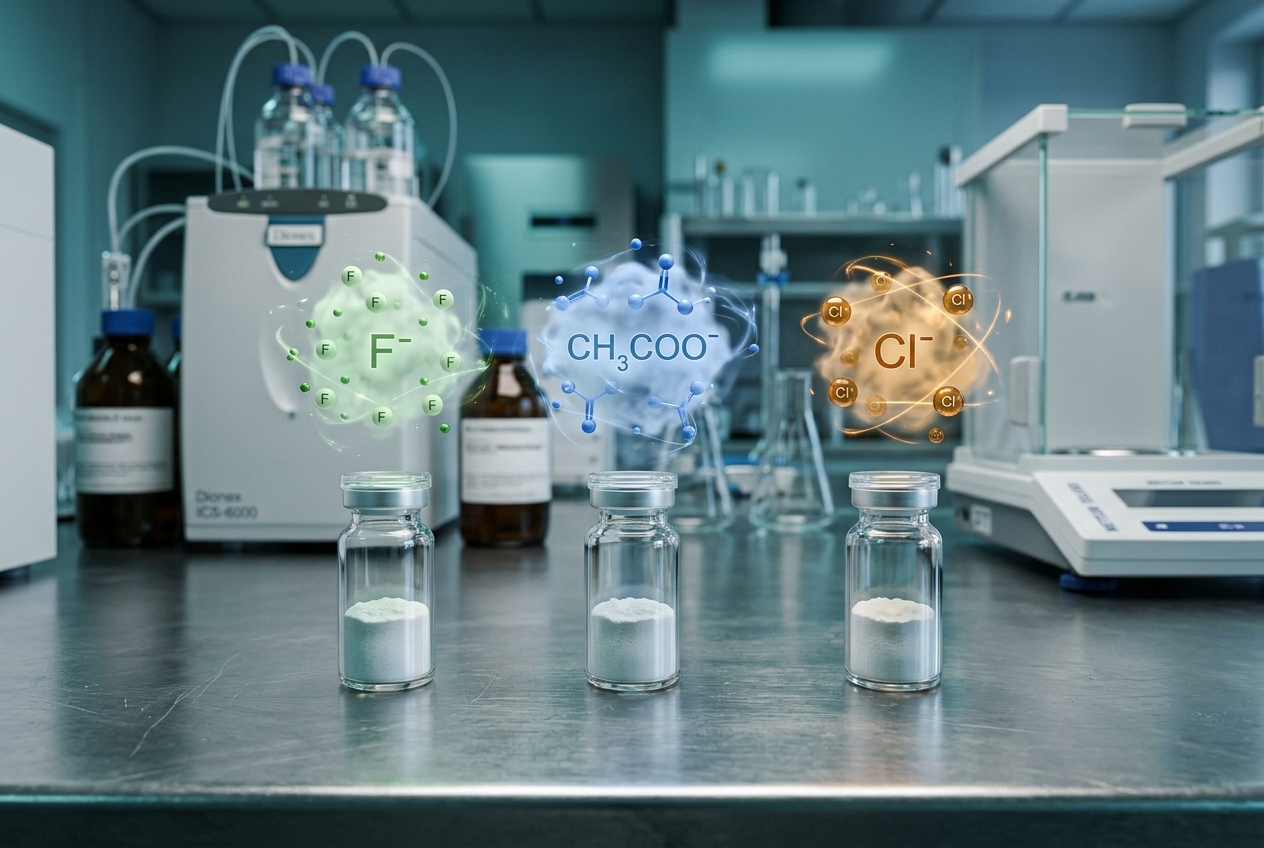
Almost every synthetic research peptide ships as a salt, not as a free base. During synthesis and purification the peptide picks up a counter-ion, most often trifluoroacetate (TFA), acetate, or chloride (HCl). The counter-ion is easy to overlook, but it affects three things every QC team cares about: the true net peptide content of the vial, the behaviour of the peptide in sensitive assays, and compatibility with cell-culture work. A vial labelled "5 mg" of a TFA salt does not contain 5 mg of peptide.
Why the salt form exists
Peptide synthesis by solid-phase methods uses TFA in the cleavage and deprotection steps, so the crude peptide is naturally isolated as a TFA salt. For many research uses this is fine. But TFA is a known confounder in certain assays and is mildly cytotoxic at higher residual levels, so peptides destined for cell culture or sensitive biological readouts are often converted ("salt-exchanged") to acetate or, less commonly, HCl.
Reference comparison
| Property | TFA salt | Acetate salt | HCl salt |
|---|---|---|---|
| Source | Default from SPPS cleavage | Salt-exchanged | Salt-exchanged |
| Typical use | General chemistry, HPLC references | Cell culture, biological assays | Specific solubility needs |
| Cell-culture compatibility | Lower (residual TFA cytotoxic) | Higher | Case-dependent |
| Assay interference | Can suppress some readouts | Minimal | Minimal |
| Counter-ion mass burden | Higher per charge | Lower | Lowest |
| Cost | Lowest (no extra step) | Higher (exchange step) | Higher (exchange step) |
Net peptide content: the number that actually matters
The single most common bulk-buyer error is treating gross vial mass as peptide mass. A CoA should state net peptide content (also called peptide content by percentage), which is gross mass minus the counter-ion, water, and any residual salts. For a basic peptide carrying several TFA counter-ions, net peptide content can be 75 to 85 percent of gross mass. When you compare suppliers on price, compare on net peptide content, not on vial-label milligrams, or you will systematically overpay for the supplier shipping the heavier salt.
How to read counter-ion data on a CoA
A complete CoA states:
- The salt form (TFA, acetate, or HCl)
- Counter-ion content as a percentage (for example, "TFA content 8.2%")
- Net peptide content as a percentage
- Residual TFA specifically, if the peptide was salt-exchanged to acetate (a good exchange leaves only trace TFA)
If the CoA gives HPLC purity but no counter-ion or net-peptide figure, it is an incomplete document for procurement purposes. Purity (how much of the material is the correct peptide) and net content (how much peptide is in the vial) are two different questions.
When to specify each salt form
- TFA salt: acceptable for general chemistry, HPLC method development, and non-cell analytical work. Lowest cost.
- Acetate salt: the default request for anything touching live cells or sensitive biological assays. Specify a residual-TFA limit.
- HCl salt: request only when a specific solubility or assay requirement calls for it.
Bulk procurement checklist
- State the required salt form explicitly on the purchase order.
- Require net peptide content (not just purity) on every batch CoA.
- For acetate-exchanged peptides, set a residual-TFA specification.
- Compare supplier pricing on net peptide content, normalised per gram of actual peptide.
- Request three back-to-back CoAs to confirm the salt form and net content are consistent batch to batch.
Working with PenLab Peptide
PenLab CoAs state salt form, counter-ion percentage, and net peptide content on every batch, and acetate salt-exchange is available for cell-culture-destined orders with a documented residual-TFA limit. Visit the bulk procurement portal or email sales@penlabpeptide.com.
Products are sold strictly for in-vitro laboratory research by KYC-verified institutional buyers. Not for human or veterinary use.
Related research articles
Research products mentioned
Important Notice: This article is for informational and educational purposes only. All products mentioned are exclusively for scientific research and are not intended for human consumption or therapeutic use.