Kisspeptin-10 and the HPG Axis: GnRH Pulsatility Research Guide
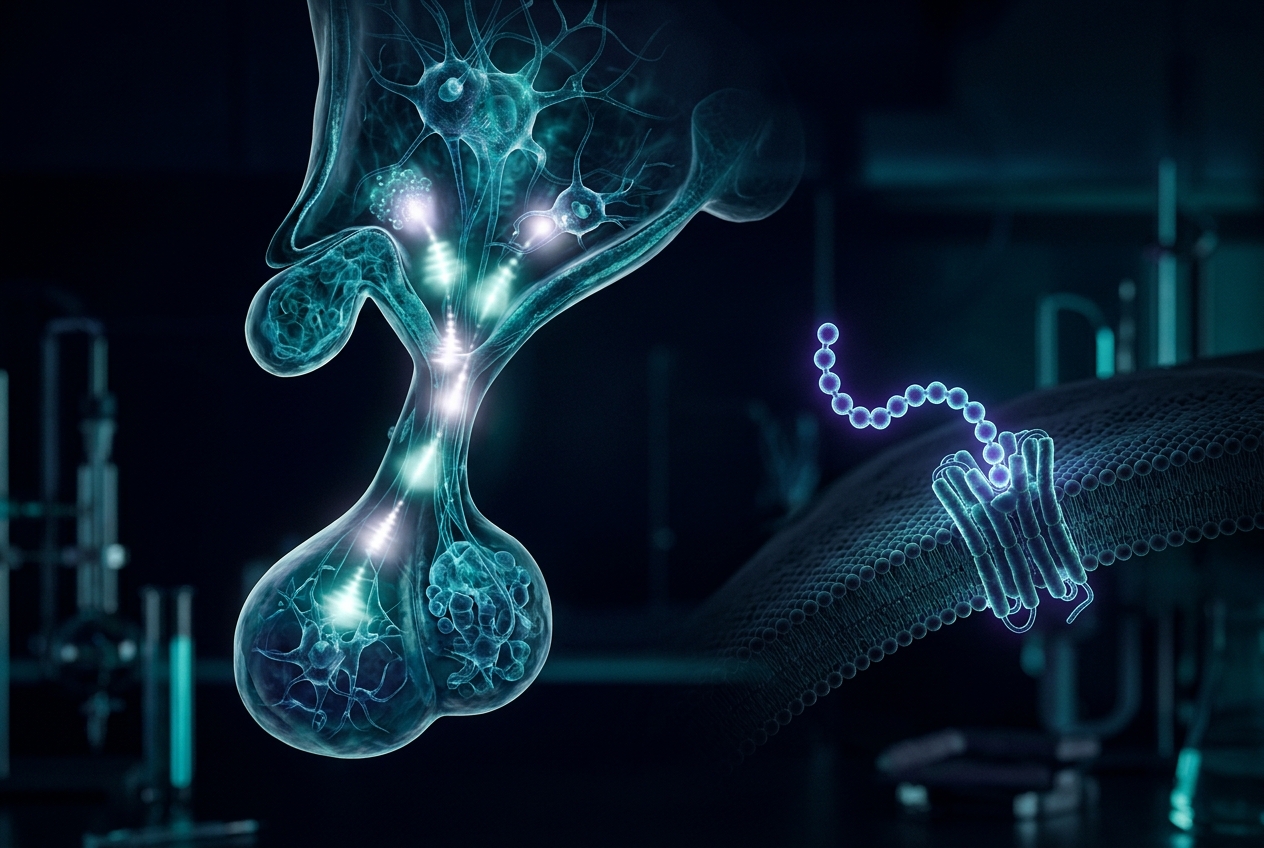
Kisspeptin-10 ist das C-terminale Decapeptid-Fragment von Kisspeptin, dem Neuropeptid, das heute als zentraler upstream-Auslöser der hypothalamisch-hypophysär-gonadalen (HPG) Achse gilt. Es wirkt auf den KISS1R (GPR54) Rezeptor auf GnRH-Neuronen und stimuliert die pulsatile Ausschüttung von Gonadotropin-Releasing-Hormon. Da es eine Stufe oberhalb von GnRH in der reproduktiv-endokrinen Kaskade sitzt, ist Kisspeptin-10 ein zentrales Werkzeugmolekül in der HPG-Achsen- und Reproduktions-Neuroendokrinologie-Forschung.
Where it sits in the axis
Die Reproduktionskaskade läuft in einer definierten Reihenfolge ab: Kisspeptin-Neuronen -> GnRH-Neuronen -> hypophysäre Gonadotrope (LH und FSH) -> Gonaden (Sexsteroide). Kisspeptin-10 ermöglicht es Forschenden, die Achse an ihrem physiologischen Auslösepunkt zu stimulieren, statt sie mit direkten GnRH-Analoga zu umgehen. Das ist relevant, weil die Achse auf das Stimulationsmuster reagiert, nicht nur auf die bloße Anwesenheit eines Stimulus.
Reference data
| Property | Value |
|---|---|
| Parent molecule | Kisspeptin (KISS1 gene product) |
| Active fragment | C-terminal 10 residues |
| Receptor | KISS1R / GPR54 |
| Residue count | 10 |
| Molecular weight | about 1302 Da |
| Downstream effect | Pulsatile GnRH release, then LH/FSH |
| Plasma half-life | minutes (rapid clearance) |
| Common format | Lyophilised powder |
Why pulsatility matters in research design
Die mit Abstand wichtigste Designvariable in der HPG-Achsenforschung ist das Expositionsmuster. Pulsatile Stimulation der Achse erhält die Sensitivität der Gonadotropen und treibt eine normale LH/FSH-Ausschüttung, kontinuierliche, nicht pulsatile Exposition neigt dazu, die Achse zu desensibilisieren und letztlich zu supprimieren (dasselbe Prinzip, das der Downregulation durch kontinuierliche GnRH-Agonisten zugrunde liegt). Die sehr kurze Halbwertszeit von Kisspeptin-10 ist in diesem Kontext ein Vorteil: Es wird schnell geklärt, was zu Bolus-artigen pulsatilen Protokollen passt. Studiendesigns, die die Pulsatilität ignorieren, erzeugen häufig nicht interpretierbare LH-Messwerte.
Reconstitution and storage
Kisspeptin-10 wird als lyophilisiertes Pulver ausgeliefert. Typische Handhabung:
- Reconstitute in sterile or bacteriostatic water, swirl gently
- Working stock: 1 to 5 mg/mL depending on assay volume
- Reconstituted stability: about 2 to 3 weeks at 2 to 8 degC; aliquot to avoid freeze-thaw
- Lyophilised stability: about 24 months at -20 degC
Aufgrund der schnellen Clearance bereiten Forschende, die mit pulsatilen Designs arbeiten, typischerweise kleine Aliquots für den Einmalgebrauch vor. Ein reconstitution calculator konvertiert mcg-Dosen in Spritzenvolumen in Einheiten.
CoA requirements for bulk purchase
Require batch-level CoAs carrying:
- HPLC purity at or above 98.0%, chromatogram attached
- MS identity with observed vs theoretical monoisotopic mass (about 1302 Da)
- Karl-Fischer water content under 8%
- Counter-ion content and identity
- LAL endotoxin under 0.25 EU/mg for any cell or neuronal-culture application
Confirm the CoA cites Kisspeptin-10 specifically; longer kisspeptin fragments (such as Kisspeptin-54) have very different handling and are not interchangeable.
Bulk sourcing considerations
- Specify the fragment length on the purchase order to avoid receiving a longer kisspeptin variant.
- Aliquot-friendly packaging matters more than usual given the freeze-thaw sensitivity.
- Scale thresholds: per-gram breaks at 25 g, 100 g, and 500 g tiers.
Working with PenLab Peptide
PenLab stocks research-grade Kisspeptin-10 in 10 g, 25 g, 100 g, and 500 g tiers with batch-level HPLC, MS, KF, counter-ion, and LAL endotoxin CoAs. Visit the bulk procurement portal or email sales@penlabpeptide.com.
Products are sold strictly for in-vitro laboratory research by KYC-verified institutional buyers. Not for human or veterinary use.
Verwandte Forschungsartikel
Erwähnte Forschungsprodukte
Wichtiger Hinweis: Dieser Artikel dient ausschließlich Informations- und Bildungszwecken. Alle genannten Produkte sind ausschließlich für die wissenschaftliche Forschung bestimmt und nicht für den menschlichen Verzehr oder therapeutische Anwendung vorgesehen.